A Home-Based LIPUS Management System
A Product Line Intended to Allow Patients to Receive LIPUS Treatment at Home
The purpose of this project is to create a home-based management system for low-intensity pulsed ultrasound (LIPUS) treatment. LIPUS works by stimulating osteogenesis and is typically used to quicken the healing of broken bones. Our goal is to allow patients to use this technology at home. In order to accomplish this, we looked at the spatial and temporal factors necessary. We focused first on the spatial issue: how can a patient place the LIPUS system in the correct position with a minimal margin of error? We developed the novel orthopedic LIPUS aperture (NOLA) in order to solve this problem. Its purpose is to be integrated in a cast system to have a stable port for positioning the LIPUS. Next, we looked at the temporal issue. Typically, a patient can only use a LIPUS system for 20 minutes every 24 hours. In order to account for this, we designed a system using the ATmega1280 microcontroller that only allows the system to run for the designated amount of time. Together, these two systems can be used to allow hospitals to loan LIPUS systems in order to provide quicker healing of bone fractures.
NOLA
The first part of the design consisted of developing a mechanical device, the NOLA, for incorporation in the casting. SolidWorks was used to create a template skeleton device for incorporation in the casting process. Three-dimensional printing technology created the actual device from this template. Using styrofoam model, a blue “X” was used to mark the experimental site of fracture. We then proceeded to, with the help of a clinician, apply a cast to our styrofoam model with the NOLA casted into it. The first test was a visual verification test, in which we ensured the access to the marked fracture site. Verification concluded that the device allowed for adequate access to the fracture site for ultrasound gel application. We then tested the structural integrity of the cast through the application of a variety of forces. The failure of the cast to show any significant deflection allowed us to conclude that the structural integrity and mechanical stability of the cast is maintained despite the NOLA’s incorporation.
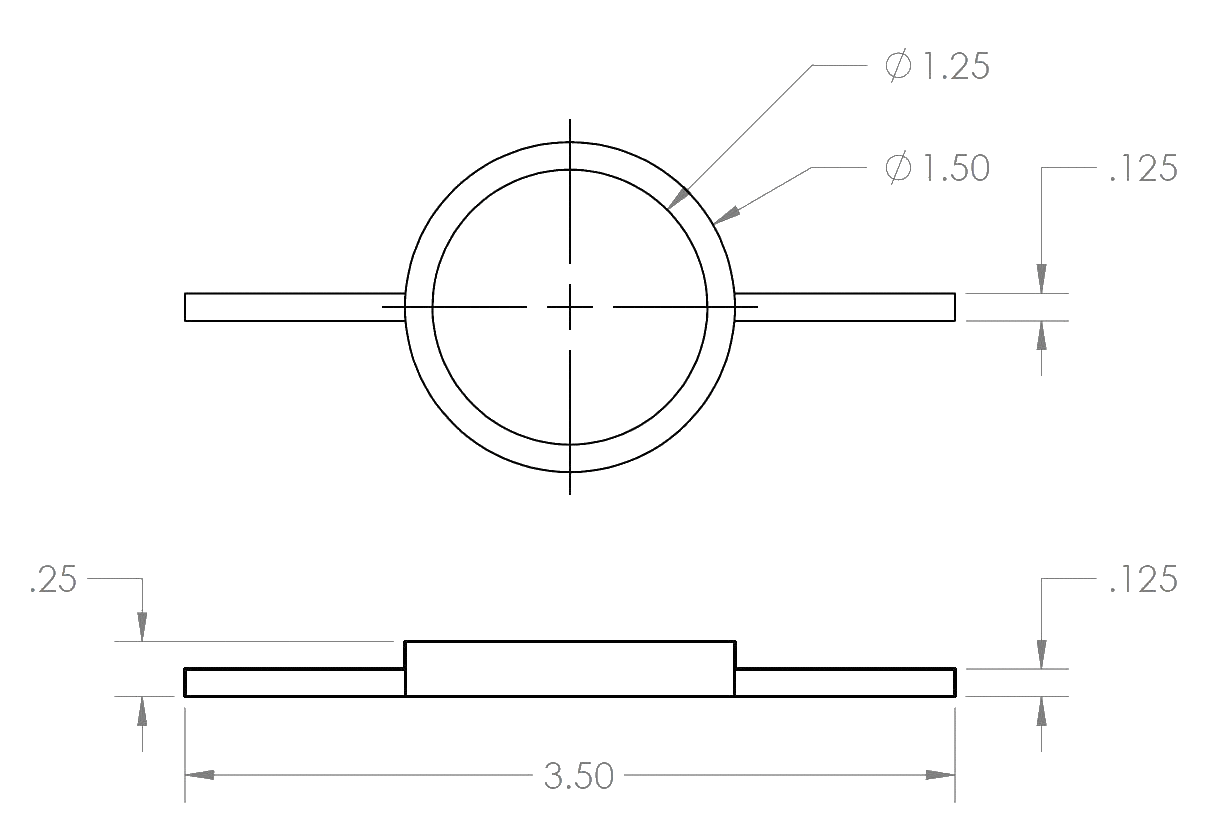
NOLA Dimensions
LIPUS Timing Regulator
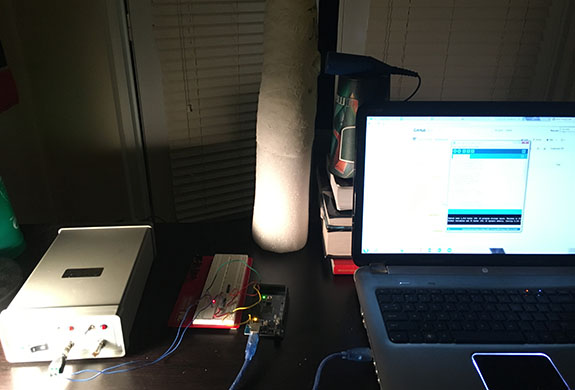
In the second semester of design, we sought to complete the LIPUS casting system by making the application feasible for patient use. Due to the dangers of excessive ultrasound exposure to patients, the LIPUS timing regulator was developed as a dual timer, arduino and circuit system to turn the system on and off based on the clinician’s recommended dosage inputs. To test this regulator, we connected it to an ultrasound system and placed the transducer on our NOLA model. We timed the running time of the ultrasound before the dosage regulator turned the machine off in addition to the time before the machine powered on again in order to verify the accuracy of the timers in the system. The input times for testing were based on a low intensity, short duration found in LIPUS research.
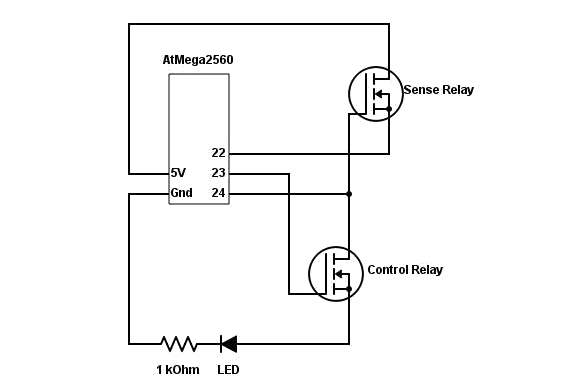
Initial Circuit Design
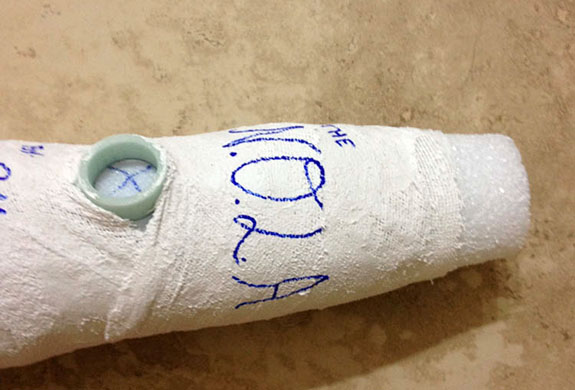
NOLA Prototype